

Most vendor switches feel justified going in. A few months later, the same problems resurface. That's not bad luck. It's a structural pattern and it has a name.
The pattern is familiar to most marketing leaders. A vendor disappoints, work comes back off-brand, turnaround slips, and communication goes quiet. You give it another quarter. Nothing improves. You switch.
The new vendor starts strong. Fresh energy, attentive account management, good first deliverables. Three months in, the same friction appears. Six months in, you're having conversations that feel like ones you've had before.
This isn't a vendor quality problem. It's a structural one. And until the structure changes, switching vendors just resets the clock.
The Data on Why Clients Actually Leave
The agency industry tends to attribute churn to client-side factors: shifting budgets, leadership changes, unrealistic expectations. But the research on why marketing leaders switch creative partners tells a more specific story.
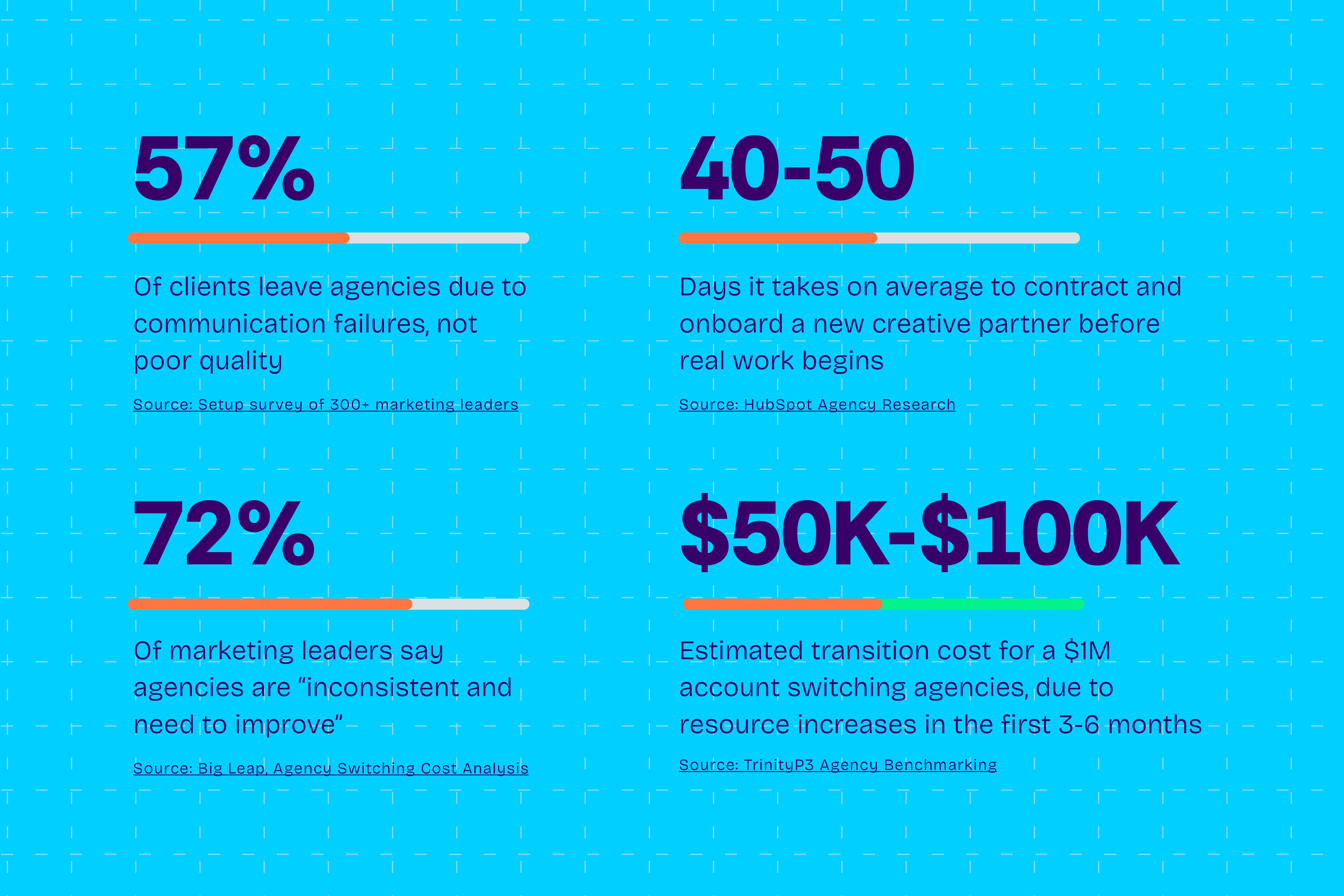
What these numbers have in common: the reasons marketing leaders leave creative partners have almost nothing to do with individual asset quality, and almost everything to do with systemic failures like inconsistency, communication breakdown, and the compounding cost of starting over.
The Vendor Switching Loop
Most marketing teams caught in repeated vendor churn are not making bad decisions. They're making reasonable decisions inside a broken cycle. The loop looks like this:
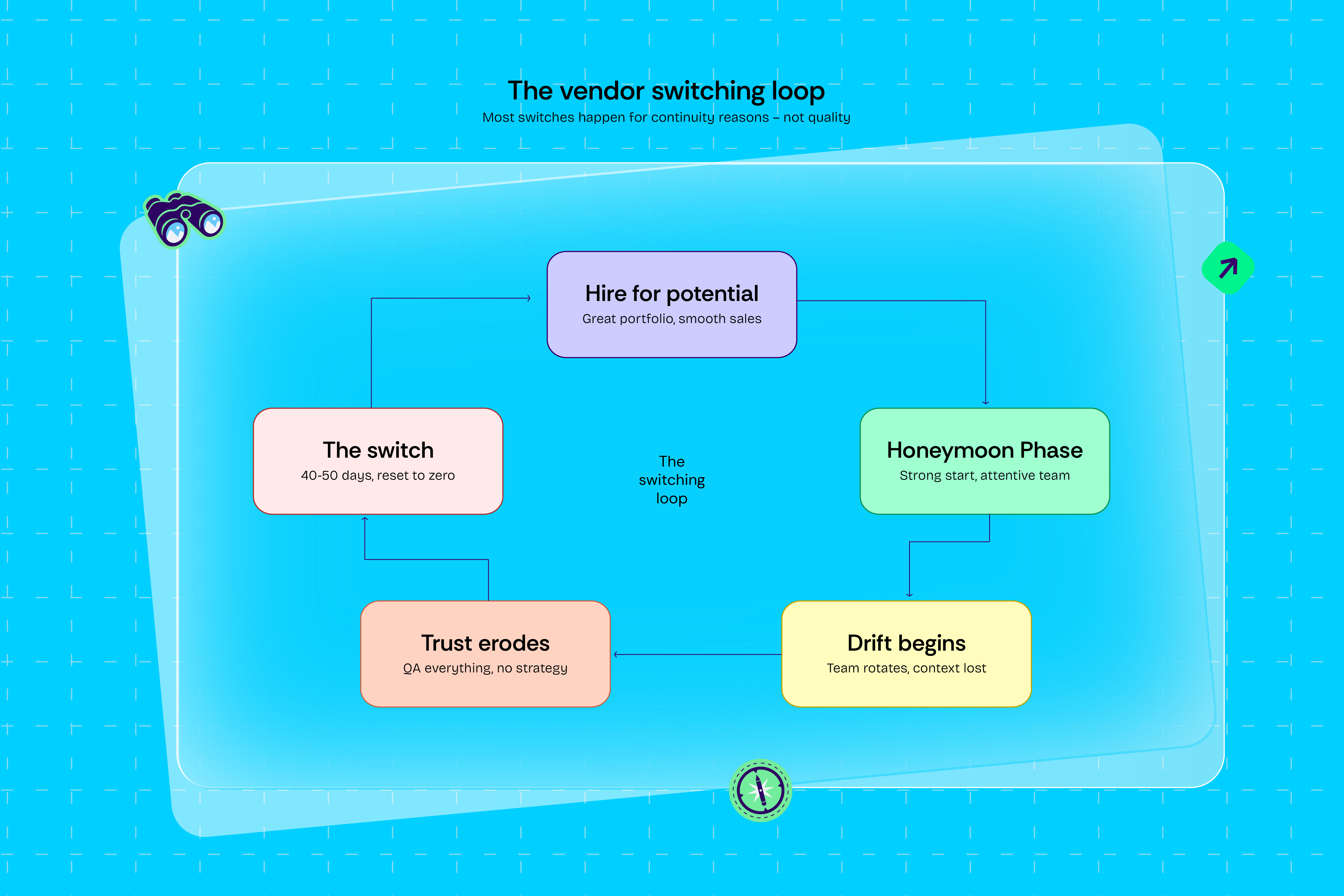
The problem isn't that vendors start badly. Most creative partnerships are not built to sustain the honeymoon.
There is no structural mechanism to preserve brand knowledge as teams rotate, volume scales, or attention shifts to newer accounts.
The drift is predictable. So is the switch.
One analysis found that clients who switch creative partners three times in five years often arrive at roughly the same strategy each time because each new partner runs the same discovery process and makes the same observations the previous one already had. Months of accumulated brand context, reset every cycle.
What Marketing Leaders Are Actually Looking For
When marketing leaders say they're switching because of "quality issues" or "poor communication," they're usually describing symptoms.
The underlying need they're rarely able to name explicitly is creative continuity, a partner whose knowledge of their brand compounds over time instead of resetting with every rotation or renewal.
The signals that this is the actual problem usually appear before the switch decision. They show up as:

Most switching decisions are triggered by continuity problems that get misread as quality problems.
A vendor can produce excellent work when they know your brand well, and mediocre work six months later when the team that knew you has moved on.
The output changed. The capability didn't.
Why the Structure of Most Creative Partnerships Makes This Inevitable
Freelancers are single points of failure: when they're unavailable, their brand knowledge disappears with them. Rotating-pool design subscriptions route work to whoever is available by design. Volume efficiency requires it, which means no single designer accumulates meaningful brand context.
Traditional agencies staff accounts based on capacity, not continuity, meaning the person who onboarded you is rarely the person doing your work by month three.
None of these structures are built to preserve brand knowledge. They're built to deliver output. And for a while, that's fine.
But as campaign complexity grows, brand nuance deepens, and the pace of always-on marketing increases, the gap between "delivers output" and "understands our brand" becomes the exact source of friction that leads to the switch.

The question to ask any prospective creative partner isn't "can you show me your best work?" It's "who specifically will be on my account in six months, and what's your mechanism for preserving brand knowledge if that person changes?"
Most vendors don't have a satisfying answer. The ones that do are built differently. See how DotYeti's dedicated pod model is structured to solve for exactly this.
What Breaking the Loop Actually Requires
Switching vendors is sometimes the right call. When there's a genuine quality problem, a values mismatch, or a capability gap that can't be closed. But most switches happen for continuity reasons that a structural change, not a vendor change, would fix.

FAQ
How do I know if it's actually time to switch vendors versus fix the relationship?
If the issues are structural like rotation, re-briefing, or drift, try addressing the model first: request a dedicated contact, define escalation paths, and document brand knowledge explicitly.
If those changes produce no improvement within 60 days, or if the vendor can't accommodate them, the structure isn't fixable from your side. At that point, switching is justified, but look for a partner built for continuity, not just one that looks better in a pitch.
Isn't starting fresh with a new vendor sometimes worth the disruption?
Yes, when there's a genuine capability or values mismatch. The issue is that most switches happen for continuity reasons, and the disruption cost (40–50 days of onboarding, performance dip, knowledge reset) is rarely factored into the decision. A switch that solves a real structural problem is worth it. A switch that moves you to the same structure with a new logo rarely is.
What's the difference between a dedicated pod and a standard agency account team?
A standard agency account team is staffed based on current capacity. The people on your account today may not be the people on it next quarter. A dedicated creative pod assigns a named team to your account and keeps them there. Brand knowledge accumulates in that team, not in a system or a handoff doc. The practical difference is that your partner gets better at your work over time instead of periodically resetting.
How long should it take a new creative partner to truly know our brand?
Functional familiarity like understanding your guidelines, tone, and visual system, typically takes 2–4 weeks of active work. Real brand knowledge such as the nuances, the preferences, and the things you'd never think to put in a brief, takes 3–6 months of consistent collaboration. That's why the onboarding period feels fine with almost every vendor. The test is what happens at month four.
Does this mean we should just tolerate a vendor that's underperforming?
No. The argument isn't "stay no matter what", it's "diagnose accurately before you switch." Tolerating structural problems without naming them leads to the same outcome as switching: the same friction, later. The goal is to identify whether you have a quality problem (switch) or a continuity problem (fix the structure, or find a partner built for continuity). These require different responses, and conflating them is what keeps the cycle running.